
Chennai Super Kings (CSK) Share Listing Date: A Beginner's Guide for Investors
Introduction
Chennai Super Kings, one of the most recognisable franchises in the Indian Premier League, is also one of the very few sports franchises in India that ordinary people can technically hold shares in. That has led many first-time investors to search for a “CSK share listing date,” expecting to find the team on a stock exchange the way they would find any other public company. This guide explains, in simple terms, what CSK's current share status actually is, how its shares are traded today, and what beginners should understand before researching this space further.
Is CSK Actually Listed on a Stock Exchange?
As of mid-2026, Chennai Super Kings Cricket Limited is not listed on the BSE or NSE, and no Draft Red Herring Prospectus (DRHP) has been filed with the market regulator. In simple terms, there is currently no confirmed IPO date and no official share listing date. Any specific date circulating online should be treated as speculation rather than fact, since only a formal regulatory filing can confirm a real listing timeline.
The company came into existence through a corporate demerger from its parent group in December 2014, which is how a section of retail shareholders originally ended up holding CSK shares. Since then, these shares have continued to change hands, but only through what is known as the “unlisted” or “pre-IPO” share market, not through a recognised stock exchange.
CSK Shares
The table below summarises commonly reported figures about CSK's unlisted shares. These are indicative data points from the pre-IPO market and can vary between platforms, so they should be treated as general reference points rather than exact, real-time figures.
Aspect | Reported Detail (Indicative) |
Company incorporated | 19 December 2014 |
Stock exchange listing status | Not listed (unlisted / pre-IPO market only) |
Official IPO / listing date | None announced as of mid-2026 |
Approx. 52-week price range | Roughly ₹174 – ₹313 per share (varies by source) |
Typical minimum lot size | Ranges from about 100 to 500 shares depending on the seller/platform |
Home ground | M.A. Chidambaram Stadium, Chennai |
Illustrative Price Trend: What Unlisted Share Movement Looks Like
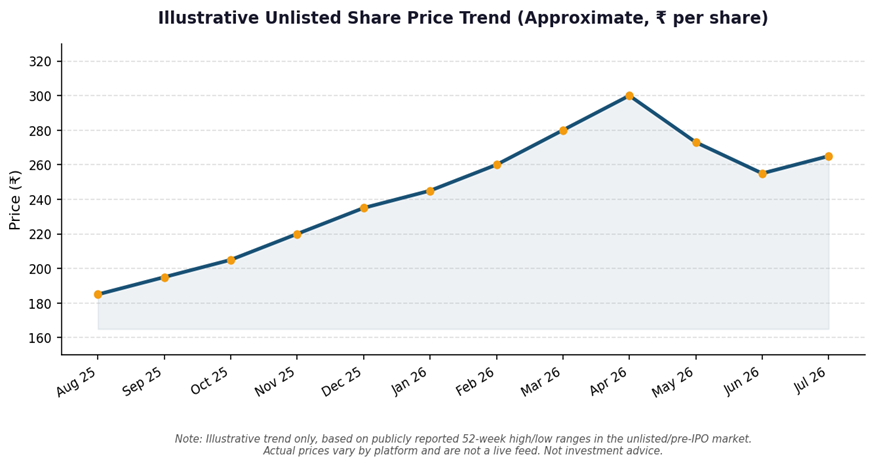
Unlike listed stocks, unlisted shares don't have a single official exchange price — prices are informally quoted by different dealers and platforms and can vary. The chart below is a simplified, illustrative visualisation (not a live feed) meant only to help beginners understand how such a price range might look over a 12-month period.
Why Isn't There an Official Listing Date Yet?
A company only gets a stock exchange listing date after it files IPO paperwork with regulators, completes disclosures, and receives approval — none of which has happened for CSK so far. Public reporting suggests the franchise generates steady income from IPL media rights and sponsorships and hasn't shown an urgent need for the kind of external capital that an IPO is typically used to raise. That's a key reason listing speculation has persisted for years without turning into an actual filing.
How the “Unlisted Shares” Market Works (Beginner Basics)
Before a company lists on an exchange, its shares can still be bought and sold informally through unlisted or pre-IPO share dealers, provided the shares are held in demat form. Because there's no central exchange setting the price, quotes can differ from one platform to another, and liquidity (how easily you can buy or sell) is generally lower than for listed stocks. Here are a few basic concepts beginners often come across in this space:
• Demat requirement: Shares must be transferred through a demat account, similar to listed shares.
• No exchange price feed: Prices are informal, dealer-quoted figures, not a regulated live market price.
• Lock-in periods: Many unlisted share purchases come with a holding period before they can be resold, especially around a future IPO event.
• Lower liquidity: Finding a buyer or seller can take longer compared to a listed stock.
• No guaranteed listing: Holding unlisted shares does not guarantee that the company will ever list on a stock exchange.
Typical Lock-In Periods for Unlisted Shares (Category-Wise)
Lock-in rules for pre-IPO shares generally depend on the type of investor. The table below outlines the broad categories commonly referenced for this kind of holding:
Investor Category | Typical Lock-In Period |
Venture Capital Funds (VCFs) / Foreign VCIs | 6 months from the date the shares were acquired |
Alternative Investment Funds – Category II | No lock-in period typically applies |
Retail investors, HNIs, and body corporates | 6 months from the date of the company's eventual stock exchange listing (if it happens) |
Key Things Beginners Should Keep in Mind
• Treat any “confirmed CSK listing date” claim with caution unless it is backed by an official regulatory filing.
• Unlisted shares carry different risks than listed shares, including limited price transparency and lower liquidity.
• Valuation of a sports franchise depends heavily on factors like media rights income, brand value, and on-field performance — all of which can change from season to season.
• Always verify facts like incorporation details, lock-in terms, and regulatory status independently before forming any view.
• This is a fast-evolving space; details around IPO plans, if any emerge, can change with little notice.
Frequently Asked Questions
Q1. What is the CSK share listing date?
Ans : There is no official CSK share listing date as of mid-2026. No DRHP has been filed with regulators, so no exchange listing timeline exists yet. Any specific date shared online is speculation, not confirmed fact.
Q2. Can I buy CSK shares right now?
Ans : CSK shares are not available on a stock exchange. They can only be accessed through the unlisted/pre-IPO share market, where transfers happen informally via demat accounts rather than through a regulated exchange order book.
Q3. Why hasn't CSK filed for an IPO yet?
Ans : Public reporting suggests the franchise earns steady income from IPL media rights and sponsorships and hasn't shown an urgent need for the external capital an IPO typically raises. This is a commonly cited reason, not an official statement from the company.
Q4. Is buying unlisted CSK shares the same as buying a listed stock?
Ans : No. Unlisted shares don't trade on a regulated exchange, have no single official price feed, generally carry lower liquidity, and may come with lock-in periods. These differences are important for beginners to understand before researching further.
Q5. Will CSK shares definitely get listed someday?
Ans : There's no guarantee. Listing depends on a formal decision by the company and regulatory approval, neither of which has happened yet. Holding unlisted shares today does not assure a future stock exchange listing.
Disclaimer:
This is written for educational and informational purposes only. Nothing here constitutes investment advice or a recommendation to buy or sell securities. All data is sourced from publicly available information. Investments in securities markets are subject to market risks — please read all offer documents carefully before investing.